
St. Landry Parish Arrest Records and Charges
Arrest records in St. Landry Parish begin on the law-enforcement side. The St. Landry Parish Sheriff's Office is the local custody agency, and the St. Landry Parish Jail is the parish jail named by both the sheriff and Louisiana Department of Public Safety and Corrections. Those records may show custody status, jail contact channels, or a link to the public jail roster. The court charge record begins later, when the District Attorney decides what charge should be filed and the Clerk of Court receives the criminal filing. That filing can become part of a 27th Judicial District Court case, a city-court matter, or another local court channel depending on the offense.
The distinction matters. A person may be arrested on one suspected offense, then face a different filed charge after review by the St. Landry Parish District Attorney. Some charges are amended, reduced, dismissed, or resolved through a plea. The jail roster and custody channels are useful for recent booking facts, while the full case file and outcome belong in the criminal court record. For custody and booking access, use the local St. Landry Parish inmate records path. For pleas, sentencing, and final disposition, use the St. Landry Parish criminal court records path.
The Louisiana DPS&C parish page identifies the local jail, Sheriff Bobby J. Guidroz, District Attorney Chad Pitre, and Clerk of Court Charles Jagneaux in the same St. Landry listing. That makes it a useful source for understanding the arrest-to-charge chain. The DPS&C St. Landry Parish page also connects the jail, DA, and clerk contacts in one place.
Use that source as a map of offices, not as a promise that one database contains every arrest record, charge, bond, and case outcome.
Find St. Landry Parish Charges After Arrest
The most direct court path is the St. Landry Parish Clerk of Court's online-service route for ClerkConnect, which the clerk labels for criminal, traffic, civil, family, and probate records. The clerk's Courts Division keeps records of criminal proceedings and is located in Suite 121 on the first floor of the courthouse. For recent booking or custody facts, use the St. Landry Parish Jail roster through LAVNS, the jail phone, or the sheriff's public-record request email. For prosecution questions, diversion paperwork, or DA-held records, use the District Attorney's office rather than assuming the clerk can answer each charging question.
- Start with the record type. Booking and custody questions go to the sheriff or LAVNS. Filed charges and court events go to ClerkConnect or the Clerk Court Division.
- Search ClerkConnect if a subscription is available. St. Landry publishes daily, monthly, and yearly court-record access with a per-page print fee.
- Use the defendant name, case number if known, court division, and filing date range when calling the Clerk Court Division at 337-942-5606 ext. 5113.
- For recent custody, check the St. Landry Parish Jail roster or call the jail at 337-948-5804 before assuming a case has already been filed.
- For prosecutor-held records, traffic diversion, or pretrial paperwork, contact the DA office using the felony, traffic, or administration lines published by the DA.
Louisiana DPS&C also points families and victims to LAVNS for incarcerated, probation, and parole searches. The DPS&C offender information page says LAVNS searches can use location, name, and ID or case number and that the system updates every 24 hours.
That state source helps when a person has moved from local jail custody to a state prison, probation, or parole record.
St. Landry Parish Charging Documents
After an arrest, the filed charge usually enters the court record through a charging document. In Louisiana criminal practice, the research record identifies bills of information and indictments as part of criminal files kept through the clerk and district court. A bill of information is a prosecutor-filed document. An indictment comes from a grand jury. A complaint or affidavit may support the first steps in a lower-level or early-stage case, but the public court file should be read by the actual document name shown in that case.
| Document | Who Uses It | What It Does | St. Landry Access Point |
|---|---|---|---|
| Complaint | Law enforcement or prosecutor | States the accusation used to start or support a case | Sheriff, city court, DA, or clerk channel depending on the case |
| Bill of information | District Attorney | Files formal charges without a grand-jury indictment | Clerk Court Division and 27th JDC criminal record |
| Indictment | Grand jury | Files formal felony charges after grand-jury action | Clerk Court Division and 27th JDC criminal record |
The 27th JDC local rules add a local detail to the arrest-to-charge path. Felony arrests are allotted among divisions, and the DA may consolidate cases. That means one arrest can later appear with a division assignment, a related case number, or combined prosecution entries.
St. Landry Parish Charge Status
Filed charges are not static. A St. Landry Parish court charge may begin as pending, then change after arraignment, plea negotiations, motions, grand-jury action, or DA review. The court record may show a charge as amended or reduced when the filed count changes. A dismissed charge is not the same as a conviction. A nolle prosequi entry means the prosecutor declined to proceed on that charge, but the exact legal effect should be checked against the case minutes and any later court order.
| Status | Plain Meaning | Record Caution |
|---|---|---|
| Pending | The charge is filed and not yet finally resolved. | Check for new hearing dates, bond terms, or later amendments. |
| Amended or reduced | The filed charge changed from the original count. | Read the current charge, not only the arrest allegation. |
| Dismissed | The court or prosecutor ended that charge. | Verify whether other counts in the same case remain open. |
| Nolle prosequi | The prosecutor chose not to proceed on that charge. | Confirm whether the entry applies to all counts or only one count. |
The District Attorney's official pages identify felony, traffic, misdemeanor, appeals, juvenile, truancy, and support-enforcement roles. For filed charge status, start with the court file. For DA enrollment or prosecution-specific records, contact the DA office directly.
St. Landry Parish Charges vs Convictions
A charge is an accusation. A conviction is the result of a guilty plea, a verdict, or another court action that establishes guilt. St. Landry Parish arrest records may show an alleged offense at booking, while the court file may later show a different formal count or no conviction at all. Public users should not treat a booking charge, open charge, or dismissed count as proof of guilt.
| Point | Charge | Conviction |
|---|---|---|
| Stage | Accusation after arrest or formal filing | Final finding or plea of guilt |
| Where to check | Jail roster, DA filing, ClerkConnect, court minutes | Court disposition, sentence, judgment, or minute entry |
| Public meaning | Not proof that the person committed the offense | Can carry sentence, probation, fines, or driver-record effects |
| Common change | May be amended, reduced, dropped, or dismissed | May be expunged from public access if Louisiana law allows |
The St. Landry Parish DA online education portal is relevant because some people receive pretrial intervention paperwork or defensive-driving traffic paperwork from the DA instead of moving through a simple conviction path.

Enrollment paths should be read from DA paperwork. The research supports the portal only for people who received qualifying enrollment or green-sticker instructions.
Statewide and Federal Charge Records
Not every St. Landry Parish arrest leads only to a parish court file. The DPS&C offender route can show state custody, probation, or parole status through LAVNS. State Police BCI handles criminal-history record modification after court-ordered expungement. Federal cases are separate from the 27th JDC. St. Landry Parish is in the Western District of Louisiana, and federal law lists Opelousas among authorized places of holding court for the Western District, even though federal public record access normally runs through federal court systems rather than parish ClerkConnect.
The 28 U.S.C. 98 federal court statute is useful when a charge or arrest involves federal jurisdiction. Federal criminal files, federal warrants, and U.S. Attorney matters should not be mixed with St. Landry Parish district-court charge records.
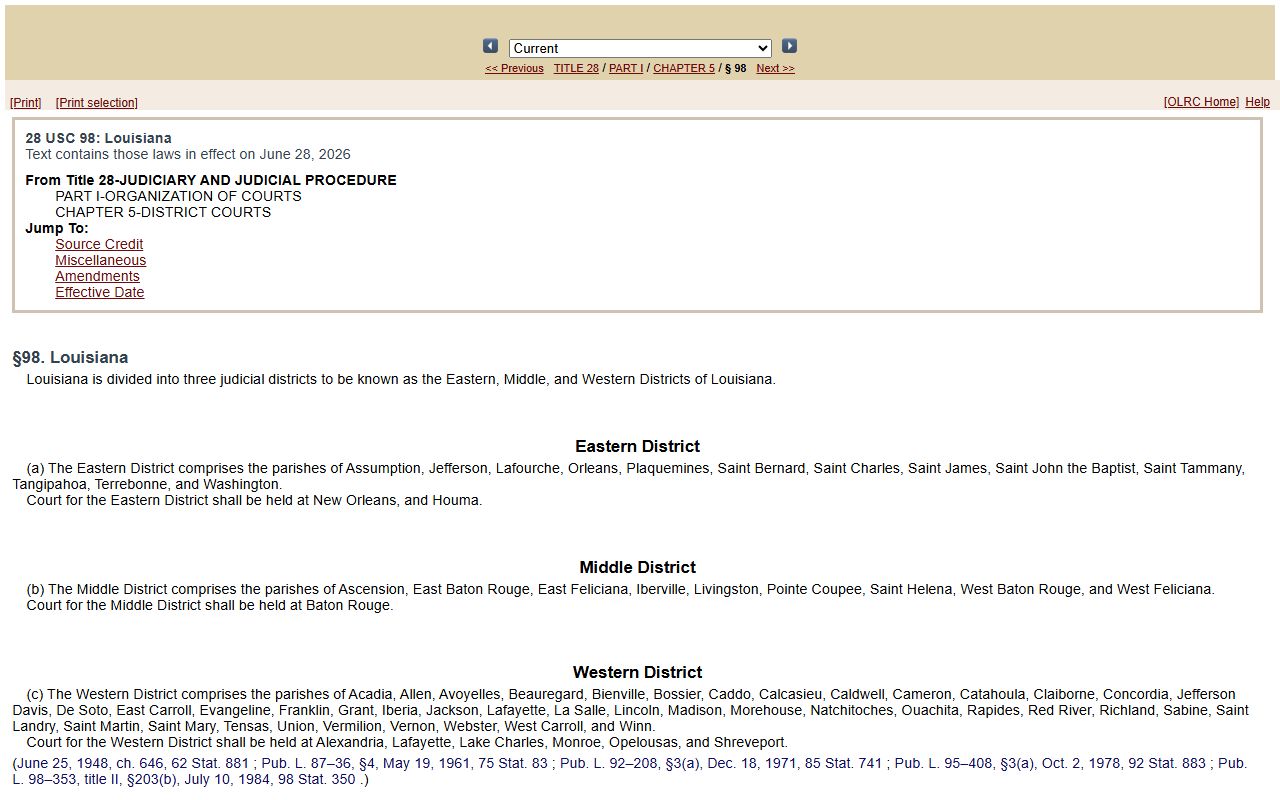
Use parish, state, and federal channels separately so a missing local record is not mistaken for proof that no case exists.
Public Access to St. Landry Parish Charges
Louisiana Public Records Law supports inspection and copying of many adult public records, but the request has to go to the right custodian. District-court filings and certified copies usually begin with the St. Landry Parish Clerk of Court. Law-enforcement records begin with the sheriff. Prosecution records begin with the District Attorney. State custody data begins with DPS&C or LAVNS. State driver history begins with OMV. Those offices may apply different fees, redactions, and request rules.
Key access rules: La. R.S. 44:31 gives adult requesters the right to inspect, copy, or reproduce public records unless another law restricts access. La. R.S. 44:32 describes the custodian's duty to provide copies or reproduction subject to lawful procedures and fees.
For sheriff legal requests, FOIA requests, or PRR/PIR requests, the sheriff contact page lists pir@slpsheriff.com. For DA public-record requests, the DA publishes a public-record request form and contact channels. For clerk-held criminal files, use ClerkConnect when online access is enough and the Court Division when certified, older, restricted, or non-digitized records are needed.
Restricted St. Landry Parish Charge Records
Several arrest and charge records are not ordinary public records. Louisiana Children's Code art. 412 makes juvenile records and reports confidential except traffic violations and disclosures the Children's Code allows. Louisiana Code of Criminal Procedure art. 971 says expungement removes qualifying arrest or conviction records from public access but does not destroy them. Adoption, interdiction, protected minor data, Social Security numbers, financial account details, and sealed court filings may also be restricted.
| Record Type | Public Access Effect | Where to Verify |
|---|---|---|
| Juvenile charge record | Generally confidential unless an exception applies | Clerk, juvenile court, or counsel |
| Sealed record | Hidden from ordinary public inspection by law or court order | Court that entered the order |
| Expunged record | Removed from public access but not destroyed | Clerk and Louisiana State Police BCI |
| Active investigation or search warrant | May be withheld while disclosure would impair law enforcement | Sheriff, DA, or issuing court |
Note: When a charge is missing from a public search, the reason may be restricted access, an unfiled case, a different custodian, or a spelling/date mismatch.