
St. Landry Parish Criminal Court Records
A criminal court record is the case-level file kept once charges enter the court. In St. Landry Parish, the Clerk's Court Division keeps records of criminal proceedings, and the 27th Judicial District Court hears criminal cases in Opelousas through four divisions. The court file may include a bill of information or indictment, minute entries, arraignment, bond orders, motions, continuances, plea entries, verdicts, sentencing orders, probation conditions, and notices of appeal.
That file should not be confused with an arrest or jail roster entry. A booking record can show custody status and arrest-related details. The criminal court file shows what the prosecution filed, what the judge ordered, and how the court resolved the charge. For a closer look at the charging step itself, use the St. Landry Parish court charge records page. For all civil, probate, traffic, and family case types, use the broader court records page.
Search St. Landry Parish Criminal Court Records
The local online path is the Clerk of Court's ClerkConnect registration page, which identifies criminal, traffic, civil, family, and probate records for St. Landry Parish. Full search and printing are subscription-gated. If the record is not online, the Clerk Court Division is the direct source because the clerk's court overview states that records of criminal proceedings are kept there.
- Start with ClerkConnect when the case is a St. Landry Parish district-court criminal case and online access is enough.
- Search with the defendant name, case number, record category, and date information available to you.
- Check the division, docket events, plea entries, motions, disposition, and sentencing entries before ordering prints.
- Contact the Clerk Court Division for certified copies, older files, missing online results, or restricted-access questions.
- Use city-court contacts for Opelousas or Eunice matters that are city, ward, traffic, ordinance, or bench-warrant related.
The District Attorney homepage image assigned to this page comes from the official St. Landry Parish District Attorney website.

The District Attorney is tied to prosecution records and charging decisions, while the Clerk of Court remains the custodian for the criminal case file.
St. Landry Parish Criminal Case Flow
Criminal court records follow the case from filing through outcome. The local rules state that new felony arrests are allotted among the four divisions, and the District Attorney may later consolidate more than one felony case into one division. Bond-related information from the sheriff or booking police agency must be made available to the judge fixing bail, including offense seriousness, violence or controlled-substance factors, evidence weight, prior criminal record, and ability to give bail.
Case flow: Charges Filed › Arraignment › Pretrial and Motions › Plea or Trial › Disposition › Sentencing
| Stage | What Happens |
|---|---|
| Charges filed | The DA files a bill of information, indictment, or related charging document in court. |
| Arraignment | The defendant is formally advised of the charge and enters a plea. |
| Pretrial and motions | The docket may show hearings, continuances, discovery disputes, suppression motions, and bond matters. |
| Plea or trial | The record may show a guilty plea, not guilty finding, trial verdict, acquittal, or dismissal. |
| Disposition and sentencing | The court records the final outcome, sentence, probation terms, fines, custody credit, or appeal notices where applicable. |
What St. Landry Parish Criminal Records Show
The official research did not verify a public sample ClerkConnect criminal result without subscription access, so specific result-screen labels should not be invented. The fields below are grounded in the clerk's criminal-record role, the 27th JDC local rules, and the types of criminal court file materials described in the research. A certified copy or final disposition should come from the clerk when the record is used for formal purposes.
| Field | What It Shows |
|---|---|
| Case number | The court identifier used to track the criminal proceeding. |
| Division | Division A, B, C, or D when assigned under the 27th JDC structure. |
| Defendant | The person accused in the criminal case. |
| Charging document | Bill of information, indictment, or other prosecution filing that starts the court charge. |
| Plea and hearings | Arraignment, plea entries, motions, continuances, and scheduled hearings. |
| Disposition | The outcome of the charge or case, such as guilty plea, verdict, dismissal, or other court action. |
| Sentence | Custody, probation, fine, conditions, or other punishment imposed after conviction. |
| Access status | Public, subscription-gated, certified-copy only, sealed, expunged, juvenile-confidential, or otherwise restricted. |
The District Attorney contact image comes from the official DA contact page.
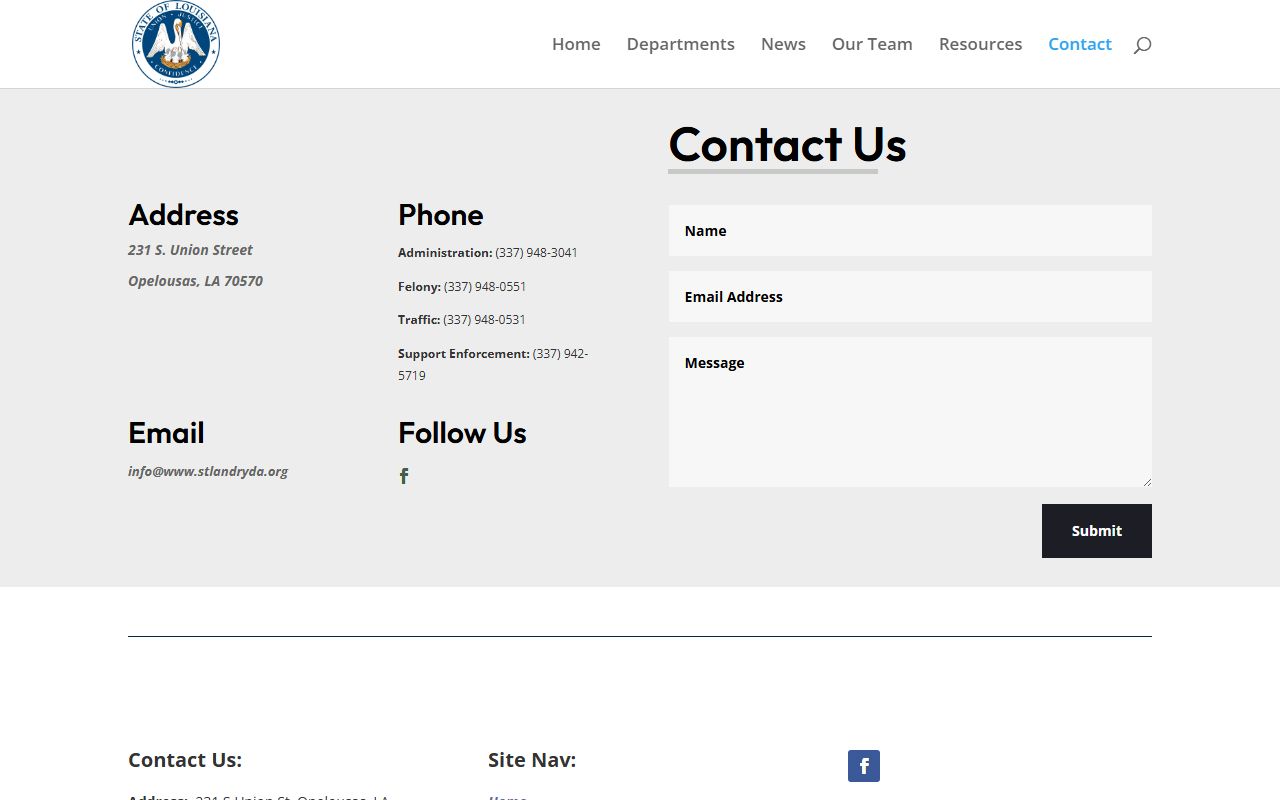
The DA contact page is useful for prosecution-related public-record requests, traffic division questions, felony division routing, and support enforcement contacts.
St. Landry Parish Charges vs Convictions
A charge is an accusation filed or pursued in court. A conviction is a guilty plea, guilty verdict, or other finding of guilt entered by the court. St. Landry Parish criminal court records can show charges that were amended, reduced, dismissed, or resolved without conviction. Reading only the charge line without the disposition can give the wrong impression of the case outcome.
| Point | Charge | Conviction |
|---|---|---|
| Meaning | An accusation or count filed in the criminal case. | A finding or plea of guilt entered in court. |
| Timing | Appears near the start or after amendment of the case. | Appears after plea, verdict, or final disposition. |
| Record risk | May remain visible even if later dropped or dismissed unless sealed or expunged. | May lead to sentence, probation, fines, or custody terms. |
| Best check | Read the charging document and later docket entries. | Read the disposition and sentencing order. |
DA and Defense Records
The St. Landry Parish District Attorney is Chad Pitre. The DA office is at 231 South Union Street in Opelousas, with administration, felony, traffic, and support-enforcement phone lines listed in the research. The DA departments pages identify felony assistants, traffic and misdemeanor roles, appeals, juvenile, truancy, DCFS work, and an Eunice office phone. DA records can involve prosecution decisions, public-record requests, diversion paperwork, and traffic education eligibility, but they are not the clerk's criminal case file.
The District 27 public defender office is listed by the Louisiana Public Defender Board at 330 East Landry Street in Opelousas. The official page lists phone, fax, hours, the number of courts and divisions, and individuals represented in calendar year 2025. Public defender files are not general public court records. The office is relevant when an eligible defendant needs appointed counsel or case representation in the district.
The DA team image comes from the official St. Landry Parish District Attorney team page.

The team and departments pages help identify the prosecution office context, but certified criminal court records still come through court and clerk channels.
The DA departments image comes from the official District Attorney departments page.

Department routing can matter for felony, misdemeanor, traffic, appeals, juvenile, and diversion questions tied to a criminal case.
Sealed and Expunged Criminal Records
Public access has limits. Louisiana Children's Code art. 412 makes juvenile court records and reports confidential except traffic violations and other authorized disclosures. Louisiana Code of Criminal Procedure art. 971 defines expungement as removing eligible arrest or conviction records from public access without destroying the record. That distinction matters because an expunged St. Landry Parish criminal court record may still exist for limited legal uses even though ordinary public search access is blocked.
| Point | Sealed | Expunged |
|---|---|---|
| Public view | Restricted by statute or court order. | Removed from public access under Louisiana expungement law. |
| Record existence | The record remains but is not open to routine inspection. | The record is not destroyed, based on the expungement definition. |
| How to access | Requires legal authority, party status, or court permission. | Requires the rules that apply to expunged records and authorized users. |
| Common examples | Juvenile, adoption-linked, protected, or court-sealed matters. | Eligible arrest or conviction records covered by court-ordered expungement. |
Public Access to Criminal Court Records
Louisiana public-record law supports inspection and copying of public records through the custodian, but criminal court records must still be requested from the office that holds them. For St. Landry Parish criminal court files, that generally means the Clerk Court Division or ClerkConnect for online access. For law-enforcement records, the sheriff's public-record channel is separate. For prosecution public records, the DA has its own contact routes and public-record request form.
Key Statutes:
La. R.S. 44:31 supports inspection, copying, or reproduction of public records unless another law restricts access.
La. R.S. 44:32 addresses custodian duties for providing public-record copies or reproduction.
Federal Criminal Court Records
Federal criminal cases involving St. Landry Parish are not filed in the 27th JDC. They belong to the U.S. District Court for the Western District of Louisiana and are accessed through federal court systems such as CM/ECF and PACER. The U.S. Attorney's Office for the Western District of Louisiana is the federal prosecutor, and federal records are separate from parish clerk records.
The federal prosecutor image comes from the U.S. Attorney's Office for the Western District of Louisiana page.
Use the federal district court and PACER for federal criminal dockets, while state criminal case records remain with the St. Landry Parish court and clerk system.
Restricted St. Landry Parish Criminal Records
Restricted criminal court records include juvenile matters, sealed cases, expunged records, protected personal identifiers, some ongoing investigative material, and records withheld by court order. The public record may also be incomplete when a document has been redacted or when the docket shows an event but not the full underlying filing. A caller seeking certified proof of a disposition should contact the clerk rather than relying on a screen view or third-party summary.
Important: Criminal court records are public only when no statute, seal, expungement, or court order restricts the file.